
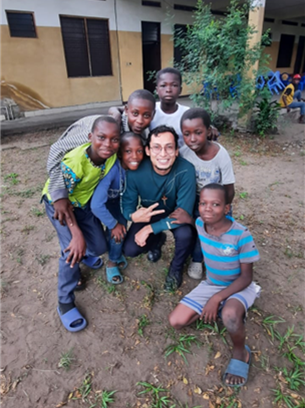
When I was 16, I met Father Alfredo Pulido, who gave me my first book on vocations. However, I was finishing high school and didn't have many things clear in my life. Then, three years later, at a spiritual retreat in October, I was fortunate enough to meet Father Alfonso Álvarez, who, with his joy and missionary witness, managed to catch my attention and awaken my interest in the mission. But it was only at age 26, thanks to Father Martín Bolaños, his simplicity, and his passion for mission, that everything became much clearer, and I was encouraged to leave everything behind for this lifestyle. As if that weren't enough, without imagining it, three years later I would meet Father Gabriel Martínez, a master of life who, with his serenity, would consolidate the foundations of my consecration to mission.
Now, why did I want to begin, my dear readers, by telling you about these parents who meant so much to my vocational process? The reason is simple. Each of them, without knowing or thinking about it, shares something in common, which is their love for the mission in Africa. All of them were missionaries on the African continent. And, with their testimony, without imagining it, they sowed in me this dream of mission. Today I can share with you that, at the age of 33, that dream has come true.
I have been on the African continent for just over a year, specifically in the Democratic Republic of Congo, in central Africa, and I am very happy. There are still days when I can't believe I am so far away, but when I look up at the sky and see the beautiful sunsets that the tropical climate of Kinshasa, the capital of Congo, provides us, I have no doubt: I am in Africa.
The African continent is very large and has many countries, all very different in social, political, and ethnic terms. Therefore, I have learned that Africa cannot be viewed from a single perspective, as its cultural diversity is majestic. That is why I am sharing with you what I experienced in the city of Kinshasa, which is the little I know so far.
In general, the people of this city are cheerful, lovers of music and soccer, and deeply religious. They are very strong physically and intellectually. They know suffering, poverty, and corruption very well. But this does not defeat them because they have a deep trust in God and their ancestral traditions; they know how to welcome the bitter moments of life with a good dose of dancing. And in the face of the different diseases they face, they always have a smile of encouragement.
In the Democratic Republic of Congo (DRC), the official language is French, and the four main local languages are Kikongo, Lingala, Swahili, and Chiluba. In addition, the country has great natural and mineral wealth, which is one of the main causes of the various violent conflicts that plague the nation. Here, there is the Zairean rite, which is an adaptation of the Roman rite of the Catholic Church, taking into account various cultural elements specific to the continent and the Congolese people. Mass in this rite is very beautiful, full of dancing and singing; a demonstration of the inculturation of the Gospel.
I am fascinated by this country, and whenever I have the opportunity to learn more about Congolese culture, I am impressed. And that is where I can see God's work in my life more clearly. He who knows everything and never tires of surprising us. During the time I lived here, in addition to learning the languages, I also reflected more deeply on God's passage through my life. And believe me, my dear readers. God lives. He is present. He is with us.
Currently, in our formation house in Kinshasa, there are 26 young men from sixteen different countries, truly living synodality and the hope of a young Church, which is journeying not only toward the sacrament of priesthood, but also toward a definitive consecration to mission. With our feet on the ground, our eyes and hands on the poorest and most abandoned, and our hearts on the cross, we are ready to continue proclaiming the good news of the Gospel with holiness and competence, following the example of Comboni. That is why, my dear readers, I continue to encourage you not to falter in prayer for an increase in missionary vocations; to continue to contribute, with what we can, our grain of sand to support formation and, above all, not to hesitate to encourage other young people to give their lives; because the mission is worthwhile, it takes nothing away from you, on the contrary, it gives you everything. God always surprises us.
Raúl Prieto Gómez, Colombian Comboni missionary