
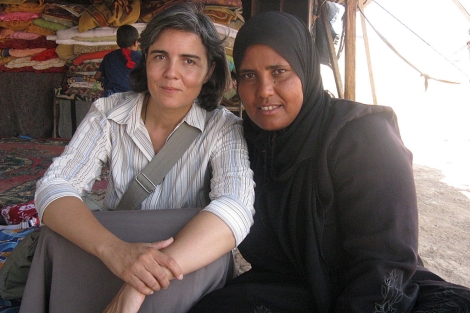
For the first time, a group of Palestinian Bedouin women found themselves surrounded by so many men who were not part of their family and did not share their language, their faith, or their land. Everything seemed to separate them... and yet something invisible and profound united them. In the humble tin and zinc hut—transformed into a meeting room and the heart of the Bedouin village of Abu Nawar—they carefully prepared for the long-awaited moment.
“They are from the Church!” we told them. “They come as pilgrims of peace.”
And they, with a mixture of shyness and dignity, opened their home and their hearts to welcome more than thirty bishops and other people from the dioceses of Lombardy, Italy, who had come to this wounded and sacred land “on a pilgrimage of peace and universal hope, to express solidarity, closeness, and support to communities affected by conflict and tension.”
The aromas of freshly brewed coffee and herbal tea mingled with the hot desert air. Jamila, the hostess, patiently organized her neighbors: each one brought coffee prepared in her own home, as if offering a blessing with each cup. The aromas of freshly brewed coffee and herbal tea mingled with the hot desert air. Jamila, the hostess, patiently organized her neighbors: each one brought coffee prepared in her own home, as if offering a blessing with each cup.
For the first time, as a concession to tradition, the women allowed themselves to be seen, sharing the same space with strange men. With steady hands and gentle eyes, they showed their traditional embroidery: colorful threads that tell their story, their resilience, their beauty.
There are about twenty-five women—grandmothers, mothers, young women—united by the desire to preserve the art of their ancestors and to weave a more dignified future with their own hands. After weeks of learning, some received their first payment that day.
“It's the first money I've earned from my own work. I feel so happy!” says Rimal, her eyes sparkling. “I dreamed of becoming a nurse, but I had to drop out of school. We walked for hours to get there, sometimes without eating. Since the war, everything has stopped... But I still dream. I love English and want to write a book. I have so many stories to tell!”
The small community hall was filled with laughter, smiles, and gratitude. The women gave each bishop a simple Christmas card, made by other Bedouin women who could not be present.
“What are they singing?” asked Naufa curiously, as she heard the bishops singing O sole mio.
“How beautiful... May they come again!” she repeated, moved.
At the end, silence fell like a cloak. The bishops, led by the archbishop, raised their hands to bless. And under the vast desert sky, God's presence was felt close by, enveloping everyone—Christians, Muslims, believers, and seekers—in the same embrace.
Amidst poverty and uncertainty, where so many borders divide, Bedouin women have woven, with their hospitality, a small prophecy:
- that even in arid land, pregnant with conflict and pain, life flourishes;
- that even in hostility, peace can be born;
- that God, the One, of all, continues to breathe life into this desert, weaving Threads of Peace among us and with us.
Sister Cecilia Sierra
Comboni Missionary in the Judean Desert