
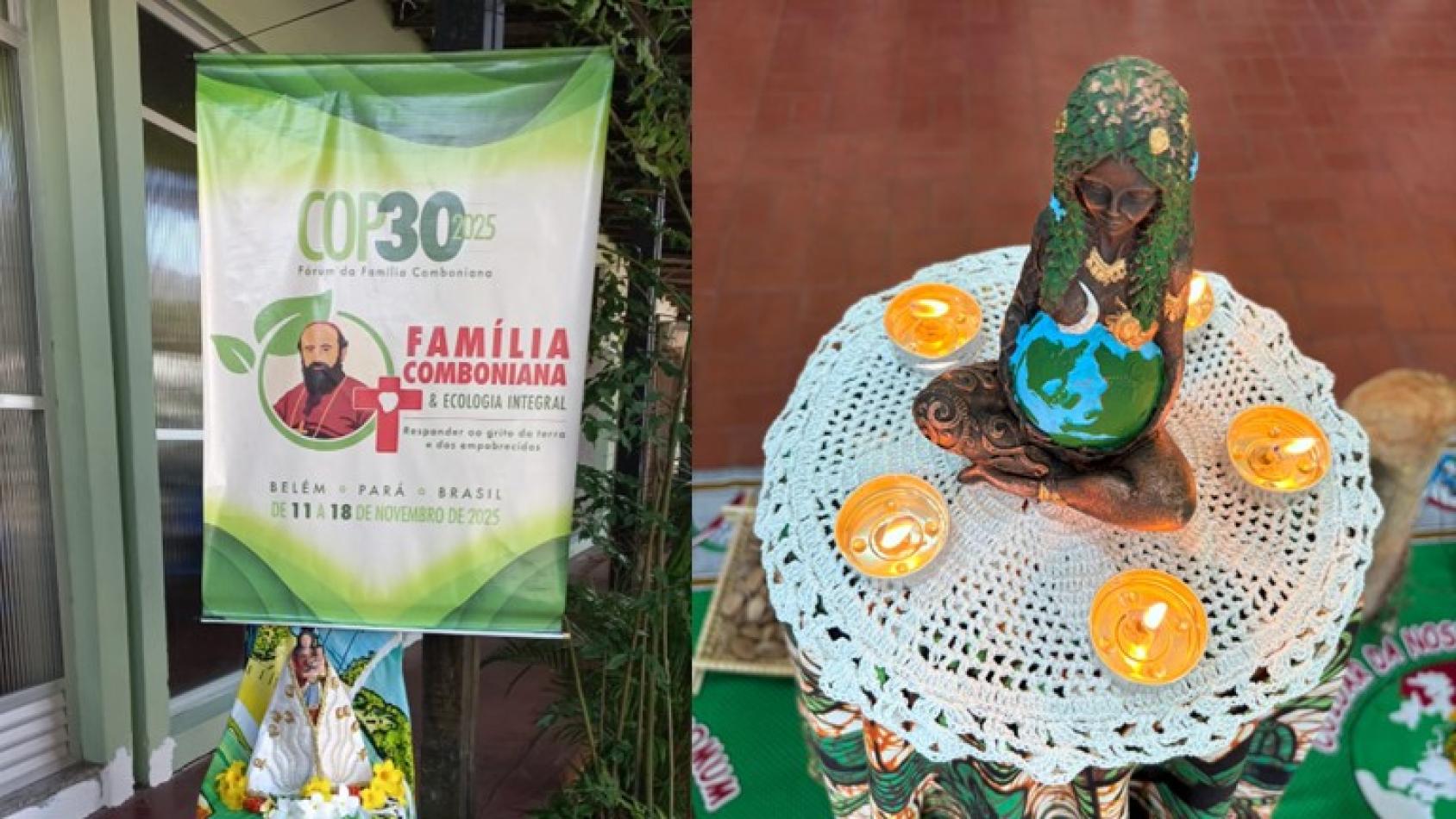
Comboni Family Forum on Integral Ecology 2025 – 1
On November 11, 2025, thirty-four members of the Comboni Family from around the world gathered at the Sagrada Família Social Center in Belém, Brazil, for the Comboni Family Forum on Integral Ecology 2025. This year's forum coincides with COP30 [November 10-21 in Belém], an international conference on climate change.
The Comboni Family Forum on Integral Ecology (FFCEI) thus offers a concrete expression of communion with those who fight for a just society that respects and protects our common home.
The opening session began with a prayer, followed by a brief introduction to the FFCEI, its purpose, and its mission. Afterwards, participants took part in group discussions, followed by a moment of sharing and the presentation of the week's program. The day ended with the celebration of Holy Mass, during which participants gave thanks to God for the gift of creation and prayed for the grace to protect it.

Comboni Family Forum on Integral Ecology 2025 – 2
Thursday, November 13, 2025
Members of the Comboni Family participated in a series of activities focused on faith, ecology, and social justice that are taking place in parallel with COP30, the United Nations Climate Change Conference, held from November 10 to 21, 2025, in Belém, Brazil.
They took part in the international symposium on the theme “The Catholic Church at COP30,” which brought together religious leaders, scientists, and representatives of indigenous peoples to discuss paths toward ecological conversion.
Another highlight was the “Tapiri,” an ecumenical and interfaith debate at the Anglican Church in Belém, where speakers emphasized the urgency of ecumenism as a platform for climate action. Participants condemned the religious and political fundamentalism that is depriving the people of the Amazon of their human rights. They stated that nature has been desacralized and turned into an object of exploitation and suggested placing nature at the center of interfaith dialogue.
A roundtable discussion on refugees and migration featured testimonies from Venezuelan, Haitian, and Beninese migrants, who shared their difficulties and praised new local initiatives supporting immigrant rights in Pará and Belém.
The day ended with a “procession of martyrs” to honor those religious and civil leaders who shed their blood in an attempt to bring justice and peace to the Amazon.
Comboni Family Forum on Integral Ecology 2025 – 3
Friday, November 14, 2025
Most participants in the Comboni Family Forum on Integral Ecology (CFFIE) in Belém, Brazil, attended two events: 1. The “Peoples’ Summit” meeting, which addressed the themes of solidarity, resistance, and hope in relation to the transition from fossil fuels to renewable energies and its effect on climate change. 2. The celebration of the 25th anniversary of the founding of VIVAT International, an organization to which the Comboni Missionaries belong.
The “Peoples’ Summit” is a conglomerate of more than a thousand associations and popular movements working for social and environmental justice. In the debates, among the topics already mentioned, it was emphasized that the energy transition must guarantee human rights, workers' rights, care for nature, and social well-being for all. People are not opposed to energy transformation, but to the way it is carried out, favoring the few and continuing to pollute the environment.
The VIVAT International celebration took place in a spiritual, festive, and joyful atmosphere. The work carried out by this organization in promoting human rights before the United Nations in New York and before the United Nations High Commissioner for Human Rights in Geneva, Switzerland, was highlighted. The day concluded with a march and prayer vigil for the earth organized by the ecumenical and interfaith organization Tapir.

Comboni Family Forum on Integral Ecology 2025 – 4
Saturday, November 15, 2025
Yesterday was another exciting moment of encounter, learning, and networking, as members of the Comboni Family Forum on Integral Ecology (FFCEI) participated in various conversations of different kinds. Two conversations stood out in particular yesterday. Both were organized by the ecumenical and interfaith “Tapiri” and hosted by the Anglican Cathedral in Belém, Brazil.
These conversations focused on the following topics: 1. Young people, women, and LGBTQ+ individuals in the fight for climate justice. 2. How organizations can contribute to combating environmental violations and racism. Speakers highlighted the need to rethink the urban migration of young people. It was noted that this phenomenon often distances young people from traditional ecological knowledge and practices, weakening existing community-driven climate protection efforts.
Furthermore, it was noted that the effects of climate change are felt by everyone, regardless of sexual orientation. Consequently, discrimination and persecution of LGBTQ+ people undermine the progress made in the fight for climate justice.
In addition, the speakers stated that organizations such as NGOs can contribute positively to the fight for climate justice by curbing environmental racism and ensuring popular participation. Hence the importance of promoting the idea of partnership. Influencing public policy requires organization. Therefore, we cannot afford to exclude NGOs from the fight for climate justice.

Comboni Family Forum on Integral Ecology 2025 – 5
Sunday, November 16, 2025
On Saturday, November 15, thousands of people filled the streets of Belém, Brazil, as part of the global march for climate change, in defense of the rights of indigenous peoples in the Amazon region and for a just transition to renewable energy.
Organizers estimated that nearly 70,000 participants walked a five-kilometer route in two and a half hours. Civil society organizations, interfaith movements, and numerous Christian groups were widely represented, all united under the call for climate justice.
During the march, posters were displayed in support of equitable land distribution in the Amazon and the rights of indigenous communities. The Church was prominently represented, with the participation of groups such as the Laudato Si' Movement, REPAM, the Church and Mining Network, the Anglican Diocese of Belém, the Franciscan Family, and the Comboni Family.
Several bishops and cardinals from the Philippines, Africa, Latin America, and Europe also joined in, demonstrating the Church's commitment to supporting the struggles of indigenous peoples and the poor most affected by climate change.
In the afternoon, some members of the Comboni Family participated in a debate on mining and the extractive economy. The speakers condemned business practices that cause the displacement of communities and the destruction of ecosystems, criticizing the race, especially by northern countries, for minerals used in the military sphere and the so-called “energy transition.”

Comboni Family Forum on Integral Ecology 2025 – 6
Monday, November 17, 2025
The People's Summit concluded yesterday with a historic and highly significant event: the official presentation of the People's Summit Declaration to the president of COP30, Ambassador André Corrêa do Lago. The document outlines the struggles and proposals to address the global climate and socio-environmental crisis. The root cause is the current economic system which, in its pursuit of profit and wealth accumulation, sacrifices nature and the life that inhabits it. It proposes to unmask the deceptive solutions of the market and ensure that natural resources are considered common goods.
At the same time, the Children's Summit concluded, and the children wrote a letter, also delivered to the president of COP30, expressing their sadness and concern about how we are destroying the world. They stated that they are not only the future, but also the present, and that they do not want to grow up in a world destroyed by war and climate change. They concluded with a call to “care for the planet as you would care for a child.”
In his brief message, COP30 President Ambassador André Corrêa do Lago said that this COP was historic because of the participation of civil society and grassroots movements. Unlike the three previous COPs, held in Belém, Brazil, at COP30 global civil society had a voice and a vote. Brazilian President Luiz Inácio Lula da Silva sent a message to the People's Summit, read by Minister Marina Silva, in which he emphasized that COP30 would not have been possible without the participation of civil society and popular movements, stating: “The fight against climate change requires the mobilization and contribution of the whole of society, not just governments,” and insisted on the need for sustainable development, “a world at peace, more united, less unequal, free from poverty, hunger, and crisis.”
After participating in all these events, the Comboni Family concluded its visit with a Eucharistic celebration presided over by Monsignor Léonard Ndjadi Ndiaye, auxiliary bishop of Kisangani, Democratic Republic of Congo. In his homily, he invited everyone to build a better world based on Gospel values.
In the context of the Meeting of Bishops of the Global South at COP30: The Poor and the Cry of the Earth, he affirmed that the Church has four priorities: 1. Educating in integral ecology. 2. The ethical dimension of energy transformation. 3. The role of women in the Church. 4. Dialogue with indigenous peoples, as action cannot be taken without their participation. He concluded by asking for prayers for peace in his country and in his diocese.

Comboni Family Forum on Integral Ecology 2025 – 7
Tuesday, November 18, 2025
Following the People's Summit, a parallel event to COP30, yesterday, November 17, the Comboni Family entered into a space of awareness, presence, and deep reflection. We began with a moment of prayer, enriched by reflections on the life and witness of Comboni martyr Father Ezechiele Ramin.
Afterwards, participants were invited to share their experiences of participating in the People's Summit. The following themes emerged from the sharing: women, the climate crisis, and the devastating effects of mining. Amidst these challenges, a strong sense of hope emerged, repeatedly expressed by communities, religious leaders, and civil society groups.
The visible involvement of religious groups, the participation of indigenous peoples, and the commitment of children and ecclesial movements were all seen as signs of life and growth.
During the afternoon session, various experiences of integral ecology were presented. These included the Laudato Si' Centers in Peru and the Democratic Republic of Congo, the ecological ministries and sustainable initiatives for women of the Comboni Sisters. The Comboni Lay Missionaries and the Comboni Secular Missionaries also presented their work in promoting ecological education and community engagement.
After group discussions, we shared our reflections. Two points emerged from the sharing: 1. Progress in the awareness and practice of integral ecology through participation in Social Forums and Comboni Family Forums. 2. Recognition of the need to make integral ecology a pillar of our mission.
The day ended with Holy Mass presided over by Father Piercarlo Mazza, an Italian Comboni missionary who works in Nova Contagem, Brazil. In his homily, Father Mazza reminded us to stand courageously alongside indigenous peoples and to confront oppressive structures with courage and faith.

Final message from the Comboni Family Forum in Brazil on Integral Ecology
“We know that all creation groans and suffers the pains of childbirth until today. And not only that, but we too, who have the first fruits of the Spirit, groan inwardly, waiting for adoption, the liberation of our bodies” (Romans 8:22).
“There are not two separate crises, one environmental and the other social, but a single and complex socio-environmental crisis” (LS, 139).
Called together by the cry of the poor and the earth, thirty-nine representatives of the Comboni Family gathered in Belém (BR) on the occasion of COP30 to experience the Forum on Integral Ecology.
From November 11 to 18, we participated in all the meetings and debates organized around COP30 and dedicated time to working together, sharing moments of spirituality and reflecting on what impacted us from what we heard and saw at COP30. These were days of encounter and listening to the Spirit present in the struggle of the Amazonian peoples and of the whole world.
We gathered in Belém with the conviction that, at this decisive moment, important pages of history are being written, together with the demands and proposals of communities in support of the multilateralism of peoples, against all denialism and against the interests of those who defend profit over life.
The Amazon, host of COP30, is a territory of resistance and inspiration, based on the ancestral wisdom and mysticism of its peoples. Listening to them confirms our perception of the serious socio-environmental crisis we are experiencing: a civil crisis that requires a profound conversion of our individual and collective lifestyles, of this economy that kills, and also of a Christian spirituality that has separated the Creator from his creatures.
The confluence of waters at the mouth of the Amazon River has united peoples from all over the world, with special relevance for an increasingly conscious and organized indigenous protagonism. It gives us hope to share the life and dreams of these peoples: in Belém we strongly feel the aroma of mission!
We feel part of a Church that is reaching out, seeking transformation, allied with ancestral and scientific knowledge, in an ecumenical and interreligious dialogue that opens minds and hearts. We celebrate the lives of many martyrs who have made and continue to make common cause with the cry of the Earth and impoverished communities.
We participated in many debates, within the institutional frameworks of the COP, the People's Summit, and the Interreligious Tapiri, and deepened our systemic understanding of the environmental and climate emergency we are experiencing. Faith communities, churches, and consecrated life have a unique potential and responsibility to offer a path of hope in this context, and that path is called the spirituality of Integral Ecology!
As people convinced and inspired by the treasure of the Comboni charism and the legacy of the social doctrine of the Church, which relaunch evangelization as the promotion of the dignity of the person in all its dimensions, we renew our commitment as the Comboni Family and propose the following lines of action:
Promote and support ecological conversion at the personal and community levels, with the aim of transforming all relationships based on inequalities and injustices (colonialism, racism, gender);
Develop processes of initial and ongoing formation on Integral Ecology and cultivate an incarnational, liberating spirituality based on network collaboration, valuing liturgical life in our communities;
Walking as a Church, valuing ongoing initiatives such as the Laudato Si' Initiatives Platform, Sowing Hope for the Planet, the Season of Creation, and Laudato Si' Week, deepening the Church's teaching and, in particular, the Appeal of the Churches of the Global South for Climate Justice and our Common Home;
Mapping and giving visibility to the practices of the Comboni Family to sensitize us to the impact of our commitment to Integral Ecology, including simple and sober lifestyles;
Recovering the Comboni Pact for the Common Home;
Collaborate with the Comboni Family media in the missionary commitment to Integral Ecology;
Include Integral Ecology in formation and popular education within our communities, with methodologies appropriate to different ages and contexts;
Support political advocacy actions from the territories, with the communities playing a leading role, also promoting activities that implement possible alternative economic models, inspired by the Economy of Francis and Clare;
Facilitate collaboration between the different branches of the Comboni Family, continuing with a General Commission, also to promote an exchange on our practices with twice-yearly training webinars.
We give thanks to God and to the peoples who welcomed us, and in a special way to the coordination team that organized the Forum and to all those who made it possible.
May this new seed planted in the soil of the Comboni Family bear fruit in a renewed commitment, in response to the urgent signs of the times!
Bethlehem, November 18, 2025.
Comboni Missionary Sisters.
Comboni Lay Missionaries.
Comboni Secular Missionaries.
Comboni Missionaries of the Heart of Jesus.